Nepal’s 2021 census counted more than half a million Gurungs, with many more living in India, the United Kingdom and beyond.
In Nepal
Nepal’s National Population and Housing Census 2021 recorded 543,790 people identifying as Gurung. The largest communities live in Gandaki Province, in districts such as Kaski, Lamjung, Syangja, Tanahun, Gorkha, Parbat and Manang, as well as in Kathmandu and Pokhara.
Language and religion
Fewer people speak Gurung as a mother tongue than identify as Gurung, a common pattern among Nepal’s indigenous languages as Nepali becomes more widely used. In the census, many Gurungs reported Buddhism, while others reported Hinduism or Bon. In practice many families mix traditions.
Beyond Nepal
Large communities also live in India (especially Sikkim, Darjeeling and the north-east), the United Kingdom, Hong Kong, the United States and other countries. Figures for these places come from different sources and years, and may count people in different ways, so they should be treated as estimates.
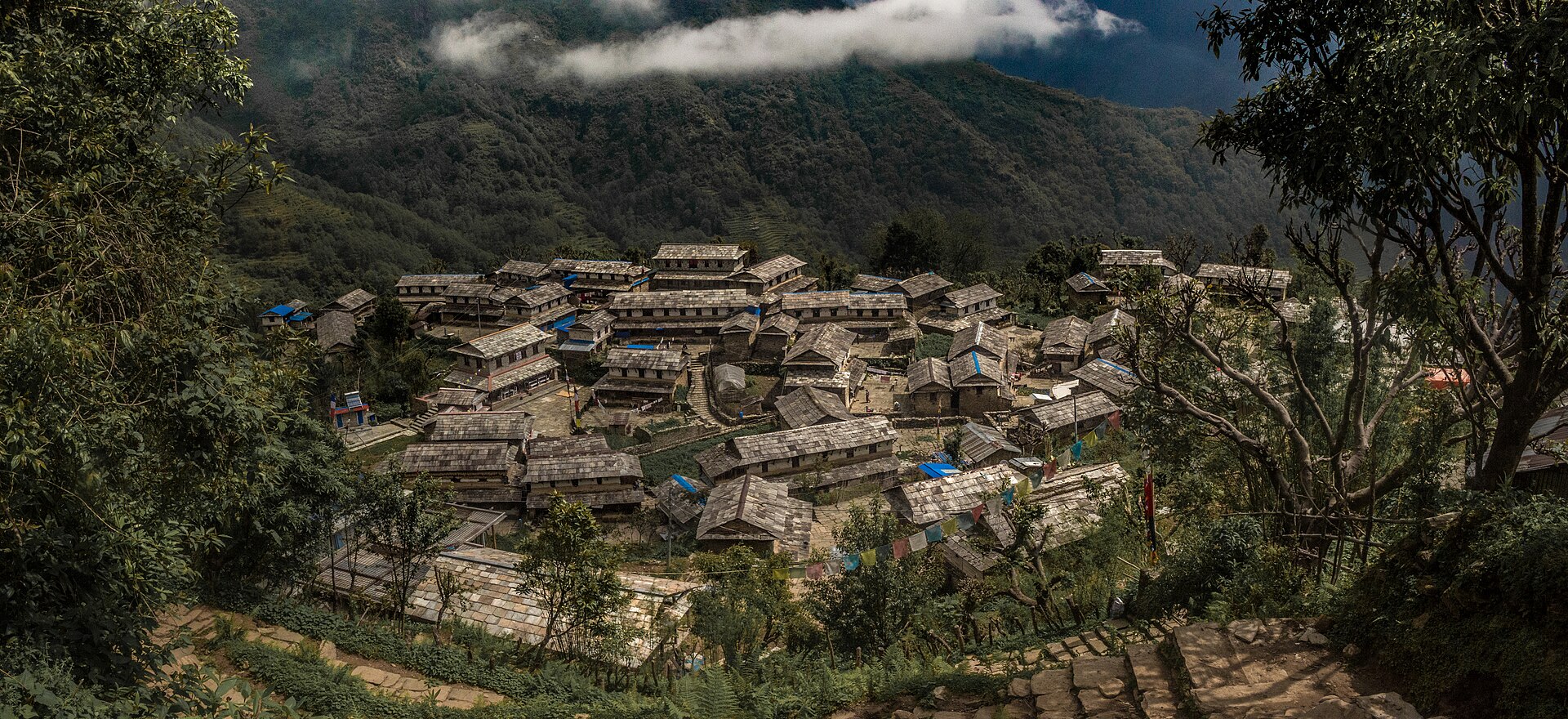
Stone houses, changing livelihoods and the relationship between tourism and community life.
A place, not a universal model
Ghandruk offers a setting for exploring Gurung heritage alongside contemporary livelihoods. Its landscape and architecture should not stand in for every Gurung village. Community practices and opportunities differ across valleys and regions.
Tourism and conservation
Adhikari and Fischer’s 2011 study examines tourism, forestry and household livelihoods in two wards of Ghandruk. It identifies benefits for livelihoods and conservation while acknowledging environmental and sociocultural trade-offs. The scope of that household research remains important when interpreting its conclusions.
Culture in everyday life
Panta’s 2023 Rodhi study adds a locally grounded discussion of cultural transformation. Read together, these studies resist presenting tourism either as an uncomplicated rescue of heritage or as the sole cause of cultural change.
A village-level view of cultural and religious relationships in Gyasumdo.
Starting with a situated account
Mumford’s study of a Gurung death rite describes Tapje in Gyasumdo, Manang. Gurung residents share the region with Tibetan communities, offering a particular example of relationships across religious and linguistic traditions.
Connections without sameness
His description includes relationships with Ghyabre and Paju practitioners and the occasional participation of Tibetan lamas in household religious life. Shared landscapes and ritual connections do not make all local communities culturally identical.
Avoiding a regional shortcut
One village study cannot establish that all of Manang is Gurung. Future profiles need their own documentation of settlement, local identity, language and livelihood rather than extrapolating a single ethnography to an entire district.
Sikles: village, language and ancestral connections
A Gurung settlement in Kaski with rich linguistic documentation, local life-cycle traditions, and connections to the Kohla ancestral landscape.
A place with several spellings
Sikles, Siklis and Sikles village appear in the sources used here. Variation in English spelling should not be mistaken for evidence of several unrelated settlements. The village is in Kaski, in the central Nepal Gurung homeland. Its significance in this collection is not simply its mountain scenery: it is a place where family, language, livelihood and specialist knowledge have been documented in detail. A photograph of today’s village shows a living settlement, not a reconstruction of ancestral times.
A centre of language documentation
ELA’s project with Narayan Gurung focuses on Sikles speech and includes work with speakers in the village as well as New York. Its account describes recorded narratives and conversations, a developing sketch grammar, and research on tone and voicing. The village’s Eco Museum also appears in ELA’s overview as the location of a map showing close to one hundred Gurung villages. The map is a community-oriented representation of settlement diversity, not a census of mutually unintelligible languages.
Knowledge holders and oral literature
Turin’s review of Strickland’s work names Padam Sing Gurung and Bir Bahadur Gurung as master practitioners whose knowledge supported the recording of pe in Siklis. Their presence makes the village a specific location in the history of Gurung oral-literature documentation. Treating them as knowledgeable collaborators helps move beyond descriptions that portray a village as a timeless cultural exhibit. The recorded literature represents work with particular experts at a particular historical moment.
Life-cycle rituals in a local study
Pol Bahadur Gurung’s 2022 article examines boys’ haircut and girls’ dress-giving initiation rituals in Sikles, using observation, interviews and case studies. Its abstract links the rites with recognition of maturity, family merit, gifts and renewed social relations. These are local customary accounts, not legal definitions of adulthood. The study provides a route into understanding how relatives and neighbours participate in growing up; it should not be used to prescribe what every Gurung child must do.
Sikles and Kohla are not interchangeable
Evans’s archaeological and ethnohistorical work investigates Kohla as an ancestral settlement, while Sikles is a present-day village connected to that broader landscape. Macfarlane and Indrabahadur Gurung’s older guide also places Siklis among villages with important herding traditions. These strands make Sikles useful for exploring both remembered ancestry and everyday livelihoods. They do not justify collapsing an archaeological site, a sacred journey and a contemporary community into one place or one period.
Rice below, maize and millet above: how crops, rain, household labour and livestock connect in documented village farming.
Making fields on a slope
Macfarlane and Indrabahadur Gurung describe terraced agriculture in which rice is grown in lower fields and maize and millet higher up. Terraces turn a steep slope into surfaces that can hold soil and, where suitable, irrigation water. This landscape is built and maintained, not simply a natural backdrop to village life. The authors’ account connects field walls, water management and repeated labour with a household’s ability to produce grain. It describes historically observed villages rather than a current survey of every Gurung farm.
Working with monsoon water
The World of the Gurungs describes preparation of rice fields, sowing in nursery plots and transplanting after water becomes available. In a quoted historical account, channels bring stream water into terraces and excess water passes downward from one level to the next. Repairs to walls and clearing plants that loosen stones are part of cultivation. The timing depends on rain: the text notes that a dry year altered planting work. Its calendar is therefore an example of an agricultural rhythm, not an exact schedule for all altitudes and years.
An illustrative yearly rhythm
The book’s calendar places manure carrying, building and path repair in the quieter early months; maize-field preparation and rice nurseries in spring; rice and millet transplanting around the start of the monsoon; and rice and millet harvest and threshing in the autumn and early winter. May to July are described as especially demanding. This helps explain why household work, festivals and visiting cannot be understood apart from the farming season. Changes in weather, irrigation, labour and crop choice can shift the rhythm.
More than three grain crops
The same account describes lentils, beans and vegetables grown between crops, along terrace embankments and in small gardens. Potatoes can be grown after a main harvest or in higher fields; gardens include vegetables and spices. Intercropping and the use of field edges make small holdings support a wider diet than grain production alone suggests. The book specifically discusses pulses as a source of protein in documented households. These observations are not a complete nutritional survey or a list of foods exclusive to Gurungs.
Animals, manure and people
Crop production connects with animal keeping: manure is carried to fields, fodder is cut for livestock, and returning herds may graze stubble after harvest. Labour is likewise social, with work parties assembled through exchange or payment. A field’s productivity therefore depends on relationships among people, animals, forests and water. Historical accounts help make these connections visible while leaving room for present-day changes caused by migration, wage work, machinery and new livelihoods.
The pastoral strand of Gurung livelihoods links mountain grazing, wool, field fertility and specialised knowledge of seasonal routes.
Pastoralism alongside cultivation
The guide describes Gurung livelihoods as combining animal husbandry and arable farming, with herding especially important in higher villages that had access to summer pasture. It names Siklis, Bhujung and Ghanpokhara as examples in its historical account. Sheep, goats, cattle and buffalo played different roles: sheep supplied wool, goats were associated with meat, and buffalo kept near houses supplied milk and manure. This is a differentiated economy, not one undivided practice of “mountain farming”.
Moving upward and returning
In the seasonal cycle described by the guide, herds moved toward higher grazing before the monsoon and returned through the forests in autumn. Shepherds from different villages occupied temporary summer encampments. The return linked animals with recently harvested fields, where grazing used crop residues and helped manure the land. These routes were recurring livelihood movements, not the same thing as the ancestral migrations remembered in ritual poetry. The precise timing and availability of pasture would depend on place and conditions.
Different kinds of daily work
A stalled buffalo and a flock in high pasture require different labour. The guide describes heavy loads of grass and leaves carried to village buffalo, whereas shepherds accompany moving flocks. Herding therefore divides tasks across a household and across seasons. The work depends on judging grazing conditions, caring for animals and negotiating access to land. An image of a snowy peak alone cannot show these relationships; the pastoral landscape includes forests, paths, fields and inhabited places as well as high mountains.
From sheep to textiles
Macfarlane and Indrabahadur Gurung describe local sheep wool being used for sturdy capes and rugs, while later imported wool supported different products. Harrison and Macfarlane’s film notes also document spinning and weaving. Livestock thus supplied material for clothing and household objects as well as food and fertility for fields. A textile’s history can reveal whether its fibre came from a local flock, a gathered plant or a purchased supply. Not all objects worn at a modern festival were made through the same production chain.
Remembered routes and changing livelihoods
These sources document a pastoral system at particular times, not its present extent. Schooling, migration, labour availability, conservation policies and markets can change how a family uses high pasture. A responsible local account would identify who herds now, which route is followed and which season the description concerns. Historical pastoral knowledge remains important even where households no longer keep large flocks, because it connects family memories and material culture with named landscapes.
Walls, roofs, verandas, grain stores and hearths make Gurung architecture part of an everyday working landscape.
A house is made from its surroundings
The guide describes village houses built from materials such as stone, timber and earth, while Harrison and Macfarlane’s building notes document stone quarrying and construction work. Access to material, household means and skilled labour shape what is built. The book notes that remittance income also supported substantial houses in some settings. There is therefore no single timeless Gurung house type: the stone façade familiar to visitors is one part of a longer history of materials, rebuilding and investment.
Inside and outside work spaces
The historical guide describes sleeping space downstairs and an upper area used for grain, baskets, mats and tools. Verandas extend domestic activities outside, supporting rest, child care and work. Such arrangements connect a house to farming: crops need storage, implements need accessible places, and wet-season activities need shelter. A dwelling is consequently both a place of family intimacy and an element in the productive household. Current homes may organise these functions very differently.
The hearth and the rack above it
A wood-fire cooking area forms the focal point of the interior in the guide. A suspended rack supports drying or smoking food and keeping some objects above the floor. Shelves hold dishes and vessels, and larger baskets and pots store grain, water and drink. Smoke, heat and storage are intertwined in this description. It is an account of observed domestic arrangements, not a claim that an enclosed smoky kitchen is desirable or that every Gurung household retains it today.
Maintenance is part of architecture
Earthen floors, roofs, firewood supplies and water access require repeated attention. The guide describes routine floor maintenance and the labour of collecting fuel and water. Harrison and Macfarlane record quarrying and the coordination of workers during rebuilding. These tasks make architecture a social process rather than a static object. The knowledge involved includes preparing materials, organising help and keeping the household usable through changing seasons.
Looking beyond picturesque villages
Tourism photographs often foreground stone roofs and mountain views, but the sources also invite attention to storage, sanitation, household labour and changing income. A museum reconstruction can suggest an interior arrangement, yet it cannot replace a dated account from a particular home. This archive identifies reconstructed imagery accordingly. Architectural heritage is strongest when it records the builders, household and circumstances of change, rather than requiring a living village to remain visually unchanged for visitors.
From village to Pokhara: keeping a community together
Village associations, clan gatherings and ritual life show how Gurung belonging is rebuilt in an urban setting.
Moving does not end village ties
Harrison and Macfarlane’s account of changing Gurung worlds follows people connected with Thak into Pokhara. Its film notes include visits to the Thak village association, or samaj, in 1997 and 2006. These examples show a community organised through shared village origin while living outside the village. The relationship is not simply nostalgic: people continue gathering for events and maintaining knowledge of relatives and neighbours in a new setting.
An urban social calendar
The book documents housewarming parties, wedding celebrations, ancestor rites and a memorial service in Pokhara across several years. These occasions give household relationships and ritual practice a new location. A town can therefore be a place of cultural continuity as well as change. The recorded events are specific examples, not a complete calendar for the city’s Gurung population or proof that every family practises the same rites.
Village and clan are different connections
A village association connects people through a home settlement; a clan gathering connects people through descent identity. Harrison and Macfarlane’s notes describe Kebje clan picnics as another form of urban gathering. The two networks can overlap without being identical. Someone may maintain ties to a home village and a clan while also forming friendships through work, school or religious institutions. Urban belonging is consequently made from several relationships rather than one institution replacing all others.
Education, work and language
ELA links movement to Pokhara and Kathmandu with opportunities for education and employment, alongside changes in language transmission. Families may gain access to services and new livelihoods while children hear more Nepali at school and in public life. Cultural gatherings can keep Tamu identity visible, but a festival alone cannot guarantee regular use of Tamu Kyi at home. The sources invite attention to the everyday language of families as well as public celebrations.
A network that can extend overseas
The same ethnographic book follows Thak-connected people to India, Hong Kong and Britain, showing how village relationships can stretch across several destinations. Florence Gurung’s British research offers a different, deeper study of religion and belonging overseas. Read together, these works help understand a village association as one part of a wider social landscape. They do not establish a membership list or current contact directory, and no undocumented association is invented here.
Hills, rivers and villages between the Marsyangdi valley and the Annapurna and Lamjung Himal.
Where it is
Lamjung district lies in Gandaki Province, west of Gorkha and east of Kaski. Its northern edge rises to Lamjung Himal, part of the Annapurna range, and the Marsyangdi river runs through it towards the south.
A historic kingdom
Before the unification of Nepal, Lamjung was one of the hill kingdoms of the region. Gurungs formed a large part of its people, and local traditions link early rulers with Ghale and Gurung leadership.
Villages and life
Gurung villages in Lamjung such as Ghanpokhara, Bhujung and Ghalegaun sit on high ridges with terraced fields below. Bhujung is one of the largest Gurung villages, and Ghalegaun has become known for community homestays.
Today
Lamjung remains one of the districts with the largest Gurung populations in Nepal. Roads, migration and tourism have changed many villages, while Lhosar, Ghatu and local rituals remain strong.
Annapurna Conservation Area: people and protected land
How a conservation project begun in Ghandruk in 1986 tied Gurung villages to forests, trekking and tourism.
A new idea in 1986
The Annapurna Conservation Area Project began in 1986, starting in Ghandruk. Instead of moving people out, it aimed to protect nature together with the communities who lived there. It became Nepal’s largest protected area.
Villages take part
Local committees helped manage forests, build trails and safe drinking water, and set rules for lodges. Money from trekking permits was used for conservation and local development.
Tourism and change
Trekking brought income to Gurung villages such as Ghandruk, Landruk and Chomrong. Many families opened lodges and tea houses. Research has found that tourism helped forests recover in places, while also changing work, food and family life.
Balancing future needs
Roads, climate change and young people moving away bring new questions. Communities continue to debate how to protect land, culture and livelihood at the same time.