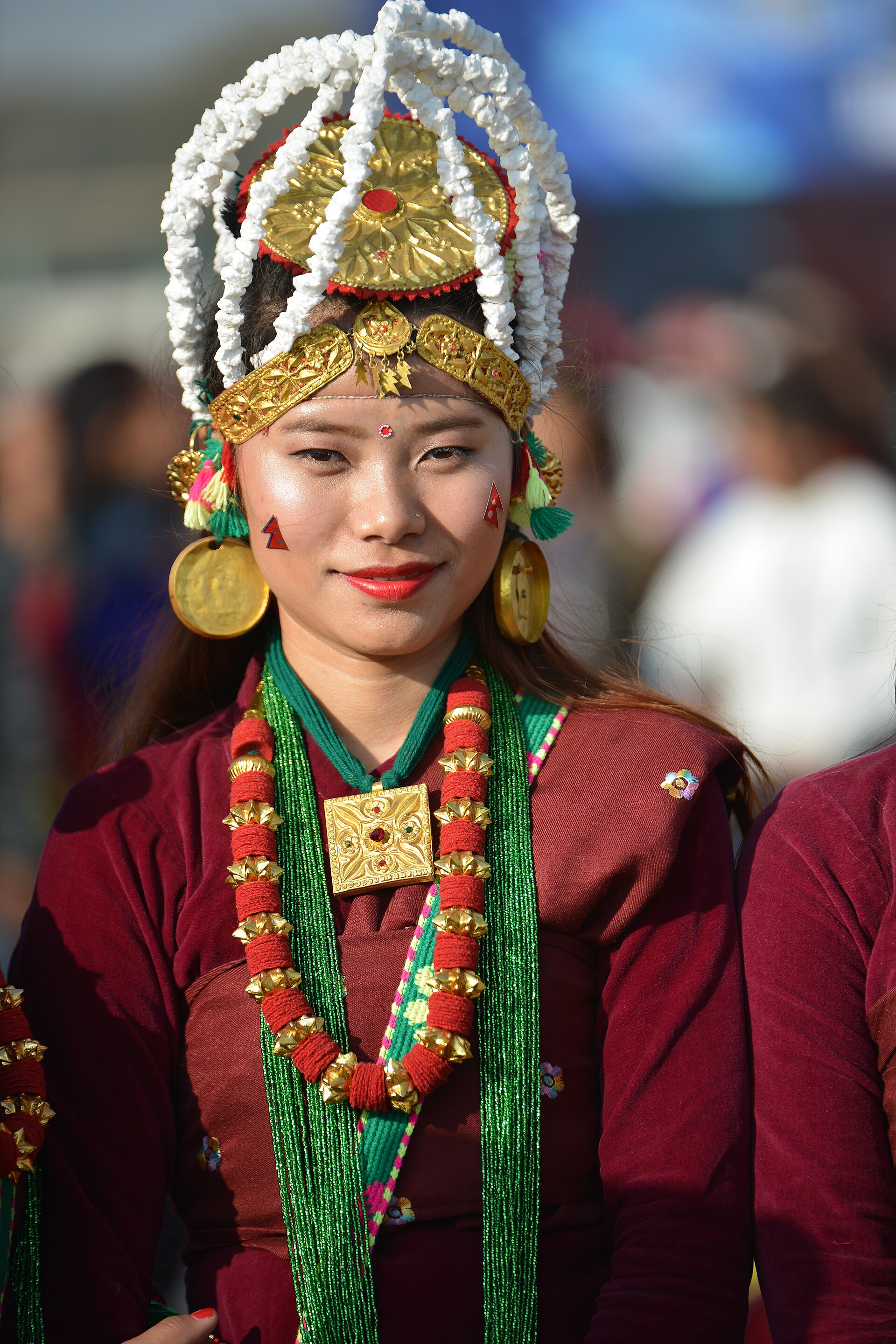
पुस्तौँदेखि बोकिएका परम्परा — गीत र नृत्यमा, कर्मकाण्डी विशेषज्ञमा, र दैनिक सामुदायिक जीवनमा।
सङ्ग्रहालयको वस्तु होइन — जिउने तरिका।
गुरुङ संस्कृति अभ्यास गरिन्छ, बहस गरिन्छ र नयाँ बनाइन्छ। तामु ल्होसारजस्ता चाडले परिवार जोड्छन्; कर्मकाण्डी विशेषज्ञले पवित्र ज्ञान राख्छन्; युवाले अपनत्व जनाउने नयाँ बाटो खोज्छन्।
धार्मिक जीवन ठाउँअनुसार फरक पर्छ — पुर्ख्यौली अभ्यासमा बौद्ध र हिन्दु परम्परा स्थानीय तरिकाले मिसिएका छन्।
घाटु
गति, सङ्गीत र सम्झनाको प्रस्तुति परम्परा।
यो सङ्ग्रहमा
रोधी
युवा भेला हुने, सहकार्य गर्ने र सामाजिक हुने ठाउँ।
यो सङ्ग्रहमा
पाच्यु र घ्याब्रे
जीवित र मृतक दुवैलाई मार्ग देखाउने कर्मकाण्डी विशेषज्ञ।
यो सङ्ग्रहमा
तामु ल्होसार
स्वदेश र प्रवासका समुदायले मनाउने नयाँ वर्ष।
यो सङ्ग्रहमा
दैनिक सम्पदा
खाना, बुनाइ, पारिवारिक उत्सव र सहकार्यको काम।
यो सङ्ग्रहमा
मौखिक साहित्य
पे / प्ये, विशेष ज्ञान र त्यो हस्तान्तरण गर्ने मानिसहरू।
यो सङ्ग्रहमा
तामु ल्होसार: गुरुङ नयाँ वर्ष
हरेक वर्ष पुष १५ गते नेपाल र प्रवासका गुरुङ समुदाय भेला भई तामु पात्रोको नयाँ वर्ष स्वागत गर्छन्।
कहिले मनाइन्छ
तामु ल्होसार नेपाली पुष महिनाको १५ गते पर्छ, जुन प्रायः डिसेम्बरको अन्त्यतिर आउँछ। नेपाल पर्यटन बोर्डले यसलाई समुदायको सबैभन्दा जीवन्त सांस्कृतिक आधार भन्छ, र नेपालमा यो सार्वजनिक बिदा हो।
बाह्र वर्षे चक्र
छिमेकी हिमाली जनताका ल्होसारजस्तै, तामु पात्रोले वर्षलाई लोहोकोर भनिने बाह्र वर्षे चक्रमा गन्छ। हरेक वर्ष कुनै जनावरसँग जोडिन्छ, जस्तै गरुड, सर्प, घोडा, भेडा, बाँदर, चरा, कुकुर, मृग, मुसा, गाई, बाघ र बिरालो। ठ्याक्कै नाम र क्रम समुदायअनुसार फरक पर्न सक्छ।
कसरी मनाइन्छ
परिवारले नातेदार भेट्न जान्छन्, चाडपर्वको खाना पकाउँछन् र परम्परागत पोसाक लगाउँछन्। सहरमा सामुदायिक संस्थाले गीत, भाषण र घाटु तथा सोरठीजस्ता नृत्यसहित सार्वजनिक कार्यक्रम गर्छन्। विदेशमा बस्ने धेरैका लागि ल्होसार अरू गुरुङ भेट्ने र बालबालिकालाई परम्परा सिकाउने मुख्य अवसर बनेको छ।
पुरानो चलन वा नयाँ भेला?
काठमाडौँ, पोखरा र लन्डनजस्ता सहरमा ठूला सार्वजनिक ल्होसार कार्यक्रम तुलनात्मक रूपमा नयाँ हुन्। ती बीसौँ शताब्दीको उत्तरार्धदेखि आदिवासी अधिकार र सामुदायिक आन्दोलनसँगै बढे। गाउँका अभ्यास र सहरका चाड सँगै छन्, र हरेक ठाउँले आफ्नै तरिकाले मनाउन सक्छ।
In Gurung belief, a person’s soul has to be guided on a journey to the realm of the ancestors after death. A rite that is not performed properly is said to leave the soul wandering, which may bring trouble to the family. The rite is known as pae in Tamu Kyi and arghun or arghum in Nepali.
Who performs it
Ritual specialists such as the pachyu and the khlyepri (ghyabri) lead the ceremony with chants that describe the soul’s path. In some places Buddhist lamas take part or perform the rite instead. Stan Mumford describes how, in Manang, these practitioners guide the soul and even speak with it through possession.
A three-day gathering
Shanti Gurung describes the arghun as a three-day event that includes the syarga and klepri dances, performed in the name of the dead. Relatives travel from far away, bring offerings, and share food and labour. The rite renews bonds between families as well as honouring the dead.
A note on respect
The chants and objects used in pae are sacred knowledge held by trained specialists. This page gives a general introduction only and does not reproduce ritual texts.
Gurung dress is recognised at Lhosar, weddings and performances, but a festival outfit is not a single uniform worn by all Tamu people. The older guide records substantial change in fabrics and everyday clothing, while the Los Angeles Gurung (Tamu) Society presents a community description of ceremonial dress. These sources have different purposes and periods. Local names, colours, available cloth and family preferences vary, so a present-day outfit should not be treated as an exact replica of one historical description.
Women’s garments and jewellery
The guide describes a layered skirt, a high-necked velvet blouse, a waist wrapping, a velvet cloth over the shoulder and a head cloth. It distinguishes a wider pleated traditional skirt from purchased lungi cloth. It also mentions gold ornaments and turquoise or other semi-precious necklaces associated with trade and town markets. Garment names need care: ghalek or ghalek-type terms should not be assumed to mean the blouse in every account; they can refer to a shoulder wrapping. This article therefore identifies clothing by its function where terminology needs local verification.
The bhangra and men’s clothing
The bhangra is the distinctive carrying cloth or back-sack arrangement crossing the chest and worn open at the back. Older descriptions connect carrying garments with woven nettle fibre, alongside a waist wrap, shirt and Nepali cap. Contemporary ceremonial bhangra may use white purchased fabric. Its practical role matters: a familiar festival form grew from carrying needs, not simply decoration. A khukuri or cap shown in an outfit is not proof of military service or an object every Gurung man must wear.
Materials tell another history
Harrison and Macfarlane document backstrap weaving and processing nettle fibre, while the guide discusses local wool and later imported cotton and wool. Some household textiles were made locally and others bought from bazaars. As materials changed, familiar garment forms could remain meaningful. Without examining the fibre or knowing the maker, a photograph cannot establish whether an item is handwoven nettle, wool, cotton or a modern substitute.
Dress as a living choice
The older accounts include young people wearing changing styles and women combining different garments. This should not be reduced to a story that modern clothing destroys identity. Ceremonial dress can communicate belonging even when everyday life uses other clothes, and inherited jewellery may hold family memories beyond its visual appearance. Any detailed catalogue would need a named owner or maker, region, date, garment term and permission, rather than treating a single photograph as a complete national standard.
In his study of Tapje in Manang, Mumford describes Gurung households maintaining relationships with Ghyabre and Paju practitioners and sometimes inviting Tibetan lamas to conduct Buddhist rites. This is a documented local example, not a national census or a description of every household.
Belief and belonging
Florence Gurung’s British research explores traditional religion, Hindu and Buddhist influences, and the ways community institutions shape belonging. Religious identities can be debated and reinterpreted; a combination of practices is not necessarily understood in the same way by all participants.
Respecting knowledge holders
Indigenous Gurung ritual traditions should not automatically be classified as Bon. Detailed descriptions, sacred recordings and ceremonial objects require both careful sourcing and consideration of permission from the people who hold that knowledge.
Terminology varies between publications and communities. Pettigrew uses pachyu and klehbri, while Mumford discusses Ghyabre and Paju. These spellings are preserved in relation to their sources rather than combined into an invented standardized vocabulary.
Guidance and sacred geography
Pettigrew describes a Pachyu funeral soul journey; Mumford examines a Ghyabre death rite in Tapje. Together, the studies introduce ritual guidance, ancestral geography and relationships with the dead without establishing a rigid division of responsibilities that applies everywhere.
Public knowledge and permission
The presence of a ritual description in a scholarly publication does not mean that every recording, chant or ceremony is open for unrestricted display. This introduction publishes no sacred performance recordings or private ritual texts.
Pirkko Moisala’s research is grounded in a Gurung mountain village and explicitly avoids claiming that all Gurungs share the same cultural practices. Her description of a 1975 performance includes a guru leading male singers, madal drummers and three teenage girl dancers in a crowded household courtyard. People watched, talked, rested and shared food while the performance continued through the night. This makes Ghatu a social event as well as a musical form: the audience, hosts and performers participate in a shared space, not a concert separated from daily life.
Sati and baramase forms
Moisala distinguishes the complete annual performance, called sari or sati Ghatu in different transcriptions, from baramase performances that present selected episodes at weddings, visits and other celebrations. Her account places the full narrative at Baisakh Purnima, around the spring full moon, and links the occasion to divine favour and the rice crop. Harrison and Macfarlane’s notes also describe opening observances near Shree Panchami and the complete performance at Baisakh Purnima. These accounts should be kept locally attributed rather than compressed into one fixed Gregorian date or duration.
A royal story, with local names
In Moisala’s account the narrative concerns King Pashuram, also rendered Pasram, Queen Yamavati and their son. Harrison and Macfarlane record forms such as Parasuram and Yampawoti, while an older account gives Satyawati. The story includes the king’s death and the queen’s immolation, the narrative motif known as sati. Telling or dancing that story is not proof that Gurung communities practised widow immolation or that the characters are independently verified historical rulers. Names and interpretations vary with the performance and its documentation.
Everyday life within the narrative
Moisala describes episodes concerning flowers, rice cultivation, hunting, fishing, marriage, battle and a hermit’s life. In her account the rice-farming episode follows the process from preparing the field and planting to eating the crop. Such sequences connect a royal narrative with recognisable work and relationships. The study treats performance as cultural knowledge: movement and music can communicate ways of understanding a world rather than simply illustrate a text. This is the researcher’s analysis of a particular tradition, not a universal explanation supplied by every performer.
Music, movement and specialist knowledge
The study describes slow rotating movements, bending and rising, overlapping voices and drum patterns that respond to the dancers rather than maintaining a mechanically fixed beat. The guru has a special role in initiating sections and explaining words that other performers may know only approximately. Moisala could not identify the performance language simply as ordinary Gurung or Nepali; other local accounts identify an older Nepali form. This difference is worth retaining. It warns against publishing an invented standard translation based only on a performance’s visual appearance.
Ritual meaning and respectful documentation
The sources describe divine presence or possession in some performances and important responsibilities for the guru and supporting participants. These are attributed beliefs and observations, not a tutorial for inducing a ritual state. Festival presentations, selected episodes and full village observances are not interchangeable. A permitted recording should identify the performers, place, date and type of performance. The photograph on this page shows Ghatu performers at a Kathmandu Lhosar gathering; it is not evidence of the full annual ceremony described in the research.
Rodhi is associated with young people gathering, singing and developing social relationships, but the older guide also connects it with practical cooperation. A group and the relationships among its members matter as much as the physical house where people meet. Calling a modern entertainment venue a Rodhi does not establish that it reproduces the village institution described by ethnographers. Local accounts are needed to understand which meanings and practices continue.
Hosts and collective responsibility
Macfarlane and Indrabahadur Gurung describe groups meeting in the home of a member’s parent or another adult who took a guiding role, called the mother or father of the Rodhi. Their account includes adult presence during visiting and overnight gatherings. This is a historically documented arrangement, not a universal specification for every Rodhi house. It also challenges outsiders’ tendency to equate mixed sociability, song and courtship with an absence of responsibility.
Singing, visiting and a wider network
The guide describes visits between groups in neighbouring villages, sometimes involving substantial walks at night and a return before daytime chores. Singing and joking created relationships across settlements as well as within a home group. Such activities help explain why Rodhi should not be reduced to a stage show or one style of duet. Its social setting could involve age peers, hosts, visitors and work companions together.
Work and leisure could overlap
In the same account young people cooperated in practical tasks, and evening sociability could accompany processing beans or wool. The boundary between a work party and a musical gathering was therefore less rigid than a modern timetable of work and entertainment might suggest. Harrison and Macfarlane separately document exchange and paid labour groups. Those observations provide context without proving that every collective labour party was a Rodhi.
Change in Ghandruk
Saroj Raj Panta’s 2023 study examines Rodhi culture and factors in its transformation specifically in Ghandruk, Kaski. It offers a local research setting for asking how migration, new livelihoods and changing social expectations affect the institution. The older guide discusses criticism of Rodhi and the effect of young people leaving villages. Neither source proves that Rodhi has disappeared from all Gurung communities or that one cause explains change everywhere.
Remembering without romanticising
A fuller account would include former participants, current organisers, women, young people and local hosts, with the place and period identified. People may value different aspects: song, friendship, work cooperation or a sense of village belonging. Preserving the institution’s history does not require treating every older arrangement as ideal or every newer form as inauthentic. This article publishes no invented song lyrics, recordings or private accounts of courtship.
Mark Turin describes pe, also transcribed pye or pe-da lu-da, as a diverse collection of oral narratives, invocations, accounts of ethnogenesis and cosmological texts. They are performed in a ritual register of Gurung. These recitations have different purposes, including supporting health and prosperity and responding to illness and bereavement. The term therefore should not be reduced to a single origin myth, a modern written scripture or an all-purpose translation for “religion”.
Learning through specialists
The review identifies master po-ju Padam Sing Gurung and master ɬew-ri Bir Bahadur Gurung as central knowledge holders in Strickland’s research in Sikles. Their expertise was essential to recording and explaining the recitations. Turin explicitly asks whether their contribution deserved more prominent recognition in the publication. This is a reminder that an archive must credit the people who transmit and interpret oral literature, not only the scholar whose name appears on a book cover.
The scale of the documented collection
According to Turin’s review, Strickland’s two 2018 volumes contain approximately 13,000 lines of annotated transcription for ninety-two pe, with synopses of forty-nine additional items amounting to roughly 4,000 more lines. They include an analytical introduction, maps, photographs, indexes and recordings on an accompanying DVD. These figures describe that published corpus; they are not a count of every recitation known in every Tamu village. The archive has consulted the review rather than claiming to have analysed all the original volumes.
Landscape and remembered journeys
Evans’s study places an ancestral migration narrative alongside archaeological investigation at Kohla. Pettigrew examines a funeral soul journey and its physical retracing by Tamu activists. Together these works show how spoken literature can name places, connect ancestors to a landscape and support collective identity. A chanted route can carry religious and historical meaning without supplying an exact calendar date for migration or a map that can be treated as an independently verified itinerary.
Publication does not remove cultural boundaries
A scholarly transcription makes a particular performance available for study; it does not make all ceremonies open to reenactment or commercial reuse. Nor do comparisons with Bon in the literature establish that every Tamu practitioner uses the same religious label. This introduction discusses the nature of the collection and its collaborators without reproducing ritual instructions, private chants or a synthetic sacred text assembled from different communities.
The guide describes rice, maize and millet as major grains of Gurung hill agriculture, with lentils, beans and vegetables alongside them. Rice dishes and millet preparations belong to a wider Nepali food landscape as well as particular Gurung households. A useful account of Tamu food therefore asks who prepares a dish, where its ingredients come from and on what occasion it is eaten, rather than declaring all foods in a Gurung kitchen uniquely ethnic. What a family eats also varies with altitude, harvest, income and access to markets.
Greens, pulses and preservation
Harrison and Macfarlane describe vegetables and pulses grown in gardens, between main crops and on field embankments. Macfarlane and Indrabahadur Gurung’s account of diet includes vegetables and preserved foods, while its house description notes drying and smoking above the hearth. Preservation lets a harvest or a slaughter supply food beyond the day it is gathered. These methods connect cuisine with seasonal labour and storage space; they are not evidence that all households prepare or consume the same quantities.
The hearth as a household centre
In the guide’s village-house description, cooking takes place around a wood fire, with a rack above it for drying food and storing some implements. Pots, grain baskets and vessels for water and drink occupy nearby space. Meals are therefore part of the house’s organisation rather than an isolated activity. Keeping a fire supplied, bringing water and preparing grain are substantial forms of work. The historical arrangement should not be taken as a requirement for contemporary Gurung homes with different kitchens and fuels.
Hospitality and ceremonial gatherings
The guide describes guests receiving food and drink and notes ceremonial exchanges in marriage and memorial occasions. Shared meals bring relatives and neighbours into the work of a gathering as well as its enjoyment. Alcoholic grain drinks appear in the historical accounts, but personal preference, religion, age and family practice differ. No one food or drink can serve as a test of authentic Tamu identity. Festival menus abroad may combine remembered village dishes with ingredients available locally.
Learning from cooks and speakers
ELA’s public Gurung recording catalogue includes a potato-curry recording, showing how ordinary food knowledge can also support language documentation. A cooking account can preserve names for ingredients, tools, textures and family habits that a formal dictionary misses. This archive has not invented a traditional recipe or assigned unverified Gurung translations to ingredients. A detailed recipe contribution would benefit from a named cook, village or family context, ingredient quantities and permission to publish the account.
The guide describes baskets for carrying and storage, trays for winnowing, mats, rain shields and wooden vessels. These are not merely decorative heritage objects: their shapes answer tasks such as moving grain, sorting a harvest, keeping rain off a worker or managing milk. The availability of bamboo, timber, wool and nettle fibre varies by place. Craft production is therefore linked to the village’s surrounding resources and to exchange with other settlements.
The backstrap loom
Macfarlane and Indrabahadur Gurung describe a loom whose warp tension is controlled through the weaver’s body, commonly called a backstrap loom. Harrison and Macfarlane’s notes accompany a 1993 film of spinning and weaving and describe older women carrying out the work especially in winter. The body is part of the tool’s operation: maintaining tension and moving the threads are learned skills. The recorded division of labour is historical evidence, not a rule about who is allowed to weave now.
Nettle fibre takes work
The guide describes nettle being washed, beaten and spun before weaving; Harrison and Macfarlane’s notes emphasise the difficulty of processing prickly plants collected in high forest. The resulting thread can make durable cloth for carrying garments and sacks. Calling such fabric “natural” can conceal the labour and discomfort involved in producing it. A bhangra seen at a present-day celebration may use purchased fabric rather than hand-processed nettle, so material should be identified rather than assumed from appearance.
Wool and changes in supply
Sheep wool was used for sturdy capes and rugs in the guide’s account, alongside later supplies of imported wool and cotton. Purchased cloth and manufactured containers also changed the demand for household production. These changes do not mean that every craft vanished at the same time. They show that an object’s cultural meaning and its materials can change separately: a familiar form may remain while the source of its fibre or the place of manufacture changes.
Recording a craft accurately
A meaningful craft record identifies the maker, material, tools, village, date and purpose of the object. It can also document how a technique was learned and whether it is still practised. The films referenced in The World of the Gurungs provide dated examples rather than generic demonstrations. This article describes those examples without offering an improvised nettle-processing tutorial or treating every woven item as a uniquely Gurung invention.
Harrison and Macfarlane describe communal work parties for fields, carrying from forests and house construction. Groups could be assembled through payment or exchange, and their film notes place a documented example in the 1990s. Work that is difficult for a single household becomes possible by coordinating several people. The arrangement also creates obligations: a day spent helping one family can be connected to help received at another time.
Exchange is not identical to wage work
The book distinguishes assembling workers on an exchange basis from hiring them. Both involve cooperation, but the relationship is different. Wage payment settles a job through money; reciprocal labour connects present help with a continuing social relationship. A historical village could use both rather than following one pure system. This distinction matters when discussing migration and labour shortages, because substituting paid workers changes more than the number of people available.
Rodhi and practical cooperation
The guide connects Rodhi groups with cooperation as well as evening sociability. Young people who sang or visited together could also work together, and some household tasks could be performed during a gathering. Its account challenges a strict separation of labour and leisure: music and joking could accompany work, while evening sociability might include processing beans or wool. Panta’s Ghandruk research adds a later, locally situated discussion of transformation rather than proving that all Rodhi institutions followed the same pattern.
Household labour can be overlooked
Collective field work is visible, but cooking, preparing food for workers, tending children, fetching water and maintaining a house are also necessary. The guide makes the sustained workload of women and older family members visible, even though some of its characterisations reflect the assumptions of its time. Cooperation should not be romanticised as proof of equal burdens or universal harmony. A fuller account asks who organises a task, who benefits and whose contribution is not counted as public work.
Continuity through different forms
Families who move to a town or abroad can continue coordinating help through relatives and village associations, even when fewer people exchange field labour. Historical sources show why such relationships matter without establishing that one institution survives everywhere unchanged. A local description should identify the task, participants, payment or exchange arrangement and period. That level of detail makes cooperation understandable as actual practice rather than a vague claim that all Gurungs are naturally communal.
Macfarlane and Indrabahadur Gurung describe marriage as joining networks of relatives as well as two individuals. Clan membership, inherited through the father’s line in their account, helps identify relationships and traditionally limits possible partners. Family negotiation can therefore concern existing ties, mutual obligations and social compatibility. This is a historically situated description, not a claim that every present-day Gurung marriage is arranged or that people without knowledge of their clan lack a valid identity.
Kinship patterns and partner choice
The guide records preferences for certain cross-cousin marriages and avoidance of marriage within one’s own clan. Kinship terminology distinguishes relationships and can encode sex and birth order. Such observations help explain the historical system, but they are not a universal marriage instruction. Local clan classifications differ, and contemporary choices and legal requirements need their own current sources. The archive does not turn an older ethnographic account into advice about whether a particular couple may marry.
Blessings and introductions
In one ceremony described by the guide, the bride and groom sit together while older relatives offer blessings, place rice mixed with milk on their foreheads and introduce themselves through the kinship terms the bride will use. The account places relatives, rather than a priest, at the centre of that particular event. The ceremony makes relationships publicly recognisable: entering a family includes learning who people are and how they are addressed. Its details should remain attached to the account rather than prescribed for all weddings.
Marriage as a process
The same guide describes marriage through more than one stage, including a later public transfer into the husband’s lineage and gifts between families. It also discusses how formal registration and urban life were changing that older sequence when the text was written. These observations show custom and state recognition interacting. They do not establish present-day legal procedure, and they should not be read as evidence that every family follows the same stages or understands their significance in exactly the same way.
Choice and changing expectations
The authors describe growing interest in marriages based on the couple’s own choice, especially in towns. Migration, education, employment and new social networks can change how partners meet while family relationships remain important. A living account of Gurung marriage therefore needs the voices of the couple and relatives, not only a list of ceremonial objects. The historical sources provide context for change without assuming that urban choices are less authentic or that older customs are uniformly remembered.
Pol Bahadur Gurung’s 2022 article identifies boys’ haircut and girls’ dress-giving rituals in Sikles as Khyaper Lapa and Nkyuee Chol Peepa. These spellings follow the publication’s abstract; local pronunciations and other transcriptions may differ. The article studies traditions in one village through participant observation, interviews and case studies. The scope matters: naming a rite in Sikles is not proof that every Gurung settlement uses the same name, age, sequence or symbolism.
Recognising a changed social role
The abstract argues that the initiation rites mark a transition in how boys and girls are recognised by community members. In its discussion of dress giving, it describes girls being treated as mature participants in agricultural and livelihood activities after the rite. This is a description of customary social recognition, not a legal age of adulthood and not a recommendation that children take on adult workloads. Ritual maturity and contemporary rights, schooling and safeguarding are separate questions.
Gifts and the presence of relatives
The study links the ceremonies with gift exchange, blessing and the gathering of close kin and neighbours. A rite concerned with one young person also provides an occasion to renew relationships among the people who attend. Gifts and work make those connections visible: preparing, hosting and offering support can affirm who belongs within a network of relatives. The abstract does not supply enough detail to publish a universal inventory of gifts or a complete ceremonial timetable.
Merit and collective meaning
Gurung’s abstract describes the rites as accumulating merit for family and community and expressing social unity through a division of work. The significance is therefore not limited to changing a hairstyle or receiving an outfit. Those visible actions are placed within a broader network of meaning, obligation and recognition. The archive preserves this distinction without inventing prayers, chants or symbolic explanations absent from the consulted material.
A carefully bounded introduction
The older guide also mentions boys’ first haircut and a custom of girls receiving adult dress. That provides a comparative historical reference, not an exact match with the Sikles study. Only the 2022 article’s abstract was accessible during this research pass; a detailed sequence, photographs or practitioner account would require the full study and appropriate permission. This limitation is stated so that a sourced introduction is not mistaken for a complete ceremonial manual.
Song is part of work, courtship, festivals and mourning. Groups sing while planting rice or walking to the fields, and young people sang question-and-answer songs in the Rodhi.
Madal and sarangi
The madal, a two-headed hand drum, keeps rhythm for dances and songs across the hills. The sarangi, a bowed string instrument, accompanies singers and storytellers.
Ritual instruments
Pachyu and Klehpri ritual specialists use their own drums, cymbals and bells during rites, especially funeral ceremonies. The sound helps to call, guide and send off spirits.
Ghatu and Sorathi
Ghatu is a sacred sung dance performed by young girls in a trance-like state, telling an old royal story. Sorathi is a dance-drama performed around festival times in many Gurung and Magar villages.
New music
Today Gurung artists mix old tunes with modern pop, and Tamu songs are shared online across the world, especially at Lhosar.
Gurungs count years in a cycle of twelve lho, each named after an animal: mouse, cow (ox), tiger, cat (rabbit), eagle (dragon), snake, horse, sheep, monkey, bird, dog and deer (boar). Names can differ by village and source.
Lhosar and the new lho
Tamu Lhosar, on the 15th of Poush (around 30 December), marks the start of a new lho year. Each Lhosar celebrations announce the animal of the coming year.
Lho and personality
People often know their birth lho, and some families use it when thinking about marriage, good days for events or a person’s character.
Shared roots
The twelve-year cycle is shared with Tibetan and other Himalayan and East Asian calendars, a sign of the long cultural links across the mountains.
Many Gurungs see the Pachyu and Klehpri traditions as the oldest Tamu religion. These ritual specialists recite oral texts called pe, heal, protect households and guide souls of the dead.
Lamas and monasteries
Tibetan Buddhist lamas have served Gurung communities for centuries, especially in northern villages. Gompas (monasteries) stand in many villages and lamas often take part in funeral rites alongside Pachyu and Klehpri.
Bon connections
Some scholars and community members link Pachyu and Klehpri practice with Bon, the old religion of Tibet. This connection is still debated.
Hindu influence
Under the Nepali state, many Gurungs also took part in Hindu festivals such as Dashain and Tihar. From the 1990s, many Gurung organisations encouraged people to identify as Buddhist or Bon rather than Hindu.
Living together
In practice families often combine traditions: a lama, a Pachyu and Hindu festivals may all be part of the same year.